How does Tower Bridge open?
THE MECHANICS OF A MOVING BRIDGE
The engineering, history, and strange moments behind the bascules that let Tower Bridge open for river traffic.
Read on
The answer in full
Why Tower Bridge needs to move
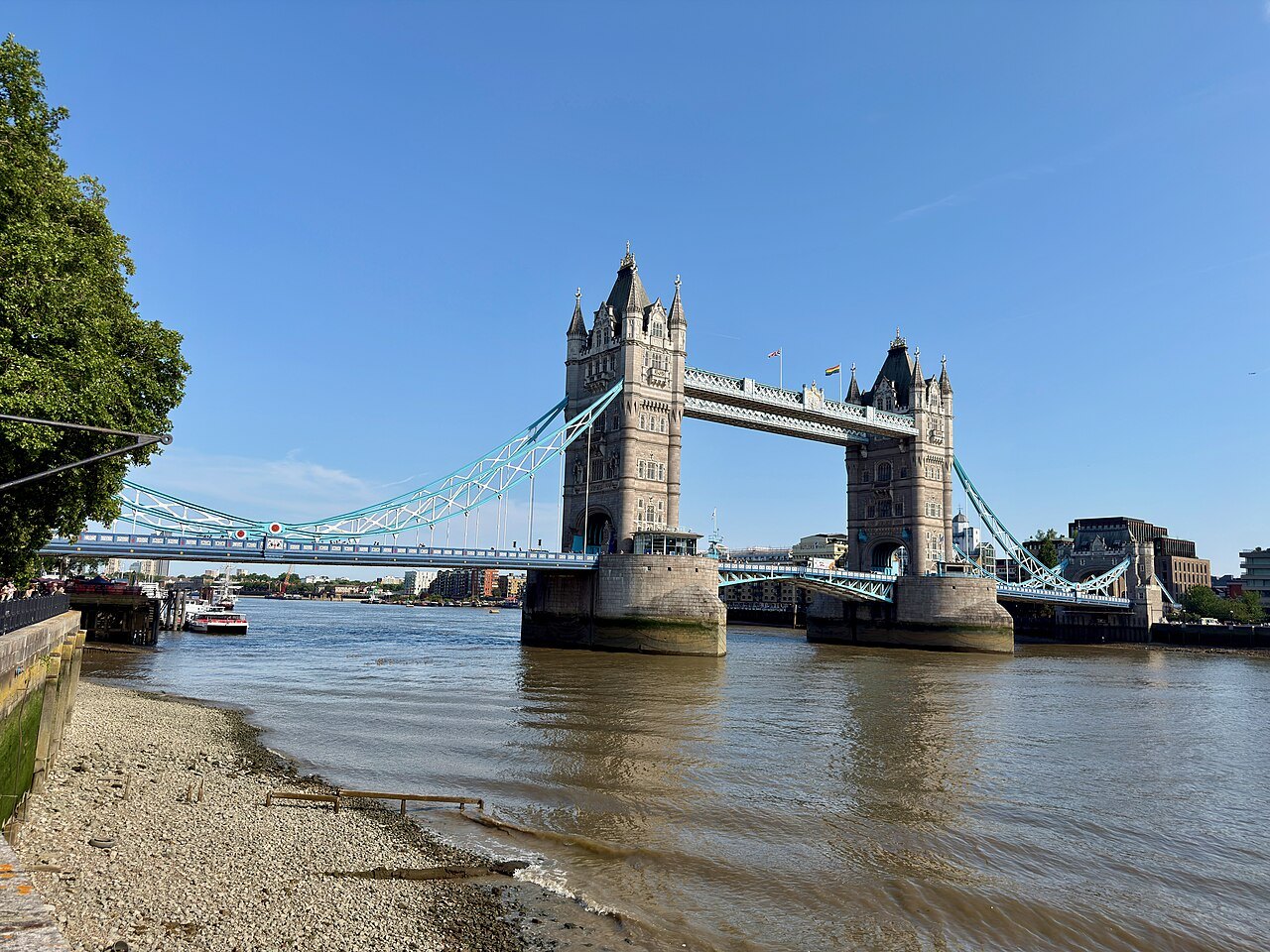
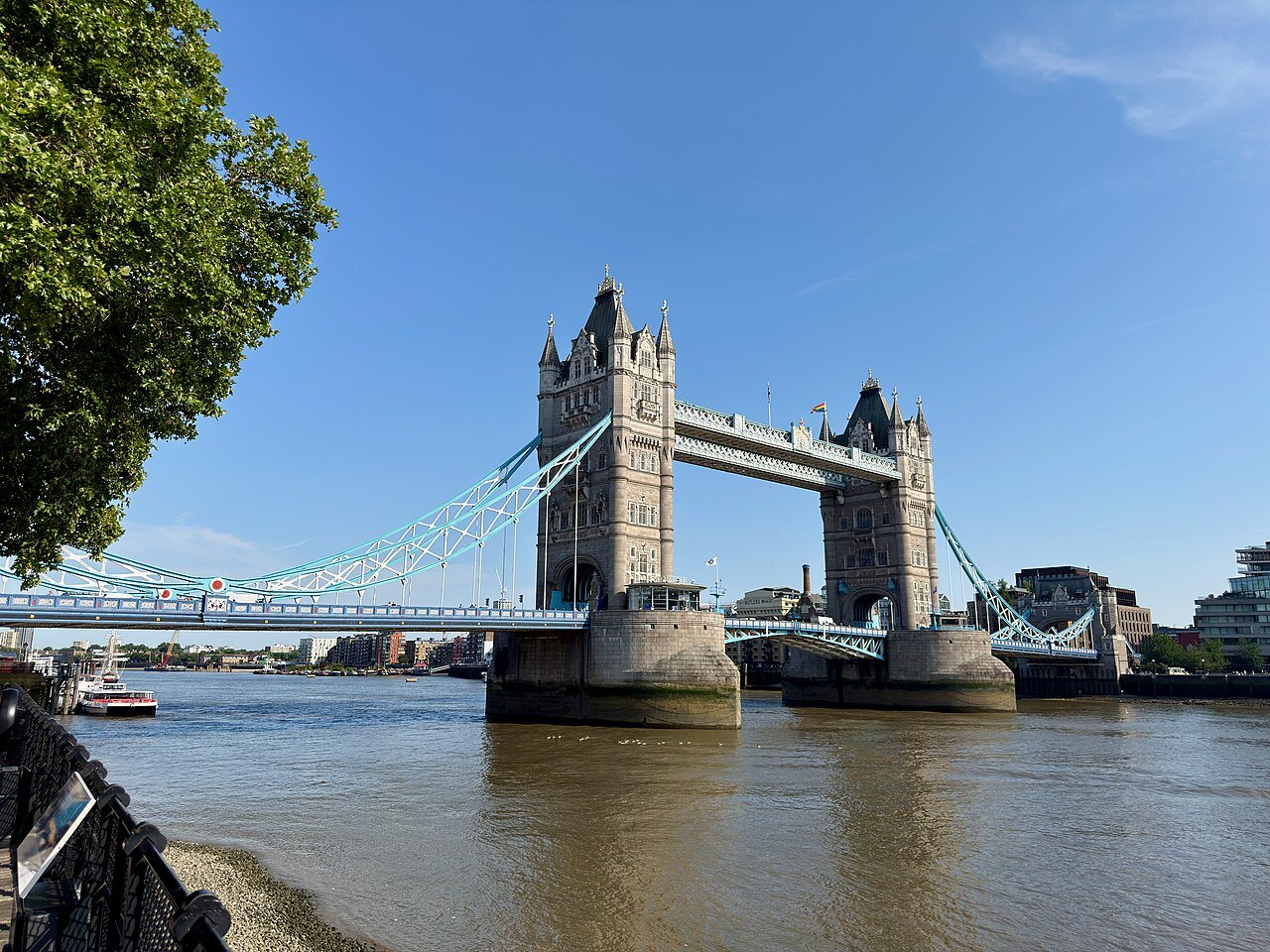
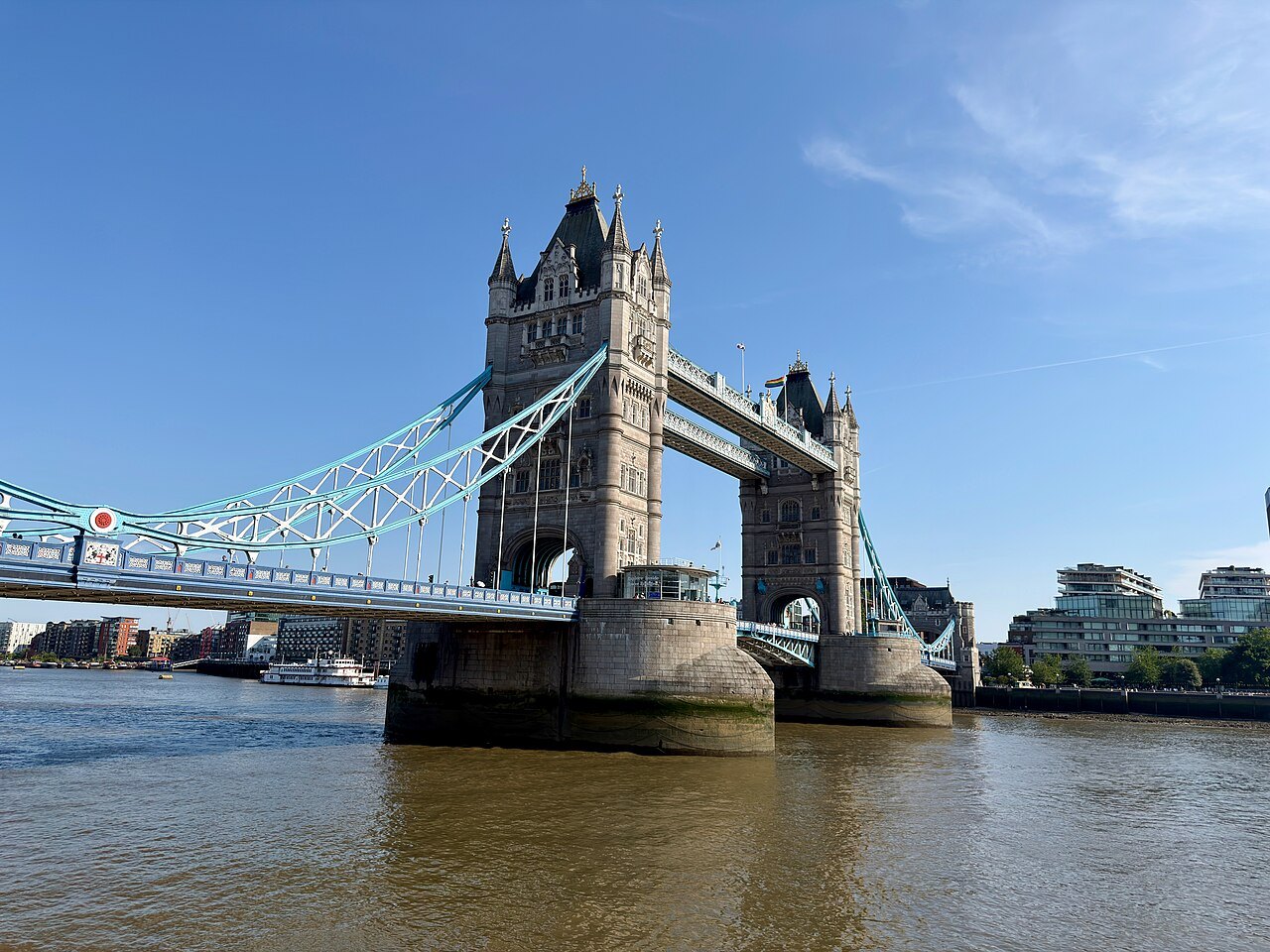
Tower Bridge looks like a fixed Victorian Gothic gateway over the Thames, with twin towers linked by high walkways, but the road itself is a drawbridge in two hinged sections, known as bascules. They are built to swing upward so that tall ships can pass beneath, and that single requirement shaped every decision made about the bridge from the start.
By the late nineteenth century the East End of London was expanding rapidly, and a new river crossing was needed downstream of London Bridge. A fixed span at street level would have sealed off the Pool of London, the stretch of river between London Bridge and the Tower of London, from the masted ships that used its docks. A bridge that could open was the only answer.
An act of Parliament passed in 1885 set out exactly what the new crossing had to do. The opening span had to give 200 feet of clear width, it had to be able to open at any time for any vessel regardless of the delay to road traffic, and its design had to match the architecture of the nearby Tower of London, which is why the towers carry turrets rather than plain steel frames.
How the lift actually works
Between the two towers, the 200-foot central span is split into two equal leaves, each a bascule hinged at its own tower. Counterweights inside the towers balance the leaves so precisely that, even though each one weighs a great deal, they can be raised through an arc of eighty-two degrees in about five minutes.
The side spans, on either side of the towers, are suspension bridges 270 feet long and do not move; only the central section lifts. Altogether the bridge runs to 940 feet including its abutments on each bank, a scale that explains why the opening mechanism needed to be so powerful and so precisely engineered.
The structure was built to withstand strong winds, a requirement added after the Tay Bridge disaster of 1879, fifteen years before Tower Bridge opened, when a rail bridge in Scotland collapsed in a storm. Tower Bridge's towers, piers and the moving leaves were engineered with that failure firmly in mind.
From steam power to electricity
The original lifting machinery ran on pressurized water, held in hydraulic accumulators and driven by steam engines, four to each pier so that a working spare was always on hand if one failed. That system kept the bascules rising reliably for the bridge's first eight decades of service, long before anyone imagined replacing it.
In 1974 the Victorian machinery was largely replaced by an electro-hydraulic system that uses oil instead of water, and today only the final gear wheels connecting to the bascules are original equipment from 1894. The old steam engines were not scrapped; they remain on public display in the engine rooms beneath the bridge, which can be visited as part of the Tower Bridge Exhibition together with the high-level walkways.
Visiting those engine rooms, and the walkways above them, requires a ticket to the Tower Bridge Exhibition rather than a ticket bought at the gate on the day. What else is worth arranging ahead of a London visit, from major attractions to timed entries, is covered in full at Booking Ahead.
River traffic still comes first
Even with modern machinery, the rule set out in 1885 still holds: river traffic has priority over road traffic, and the bridge opens for vessels regardless of the disruption to cars, cyclists, and buses below. In the first year after it opened in 1894, the leaves were raised six thousand one hundred and sixty times, an average of seventeen times a day.
Today the bridge opens far less often, something in the region of a thousand times a year, as fewer tall ships use the upper Thames. Vessels planning to pass through must give 24 hours' notice, and opening times for specific lifts are published in advance by the operator, with no charge made for the bridge to open.
Because the schedule changes with river traffic, visitors who want to see a lift should check the published opening list rather than rely on guesswork. Pedestrians can still cross on foot over the roadway whenever it is down, which means it is possible to walk across the Thames and then watch from the bank as the bascules rise for a ship.
The walkways above the road
The high-level walkways connecting the two towers were part of the original 1894 design, intended to let pedestrians cross the river on foot even while the roadway below was raised for shipping. Climbing to them meant a significant number of stairs, since they sit well above the level of the bascules.
The walkways developed a reputation as a haunt for pickpockets, and they were closed in 1910 for public use, remaining shut for decades afterward. They reopened in 1982 as the centerpiece of the Tower Bridge Exhibition, more than seventy years after they had first been shut to the public entirely.
In 2014 sections of the walkway floor were replaced with glass, so that visitors standing high above the river can look straight down through their feet to the road and the Thames beneath. It is one of the more vivid ways to understand just how high the towers really are.
Strange days on the bridge
Tower Bridge has had its share of odd and dramatic moments since it opened in 1894. In 1912 the pilot Francis McClean flew a floatplane through the narrow gap between the bascules and the high walkways above them, a stunt that would be unthinkable over the Thames today, let alone legal.
In 1952 a London bus was caught on the roadway as it began to rise beneath it; the driver, Albert Gunter, accelerated and the bus made a jump of about three feet onto the far leaf as the gap opened, with no serious injuries reported, an episode still remembered as one of the bridge's narrowest escapes.
The bridge took war damage twice: a direct hit on the high-level span in 1940, and bomb damage to the bascules, towers, and engine room from a parachute mine in 1941. More recent oddities include President Clinton's motorcade being split in two by an opening in 1997, and a Freeman of the City driving two sheep across the bridge in 1999 to exercise an ancient right.
Seeing it well
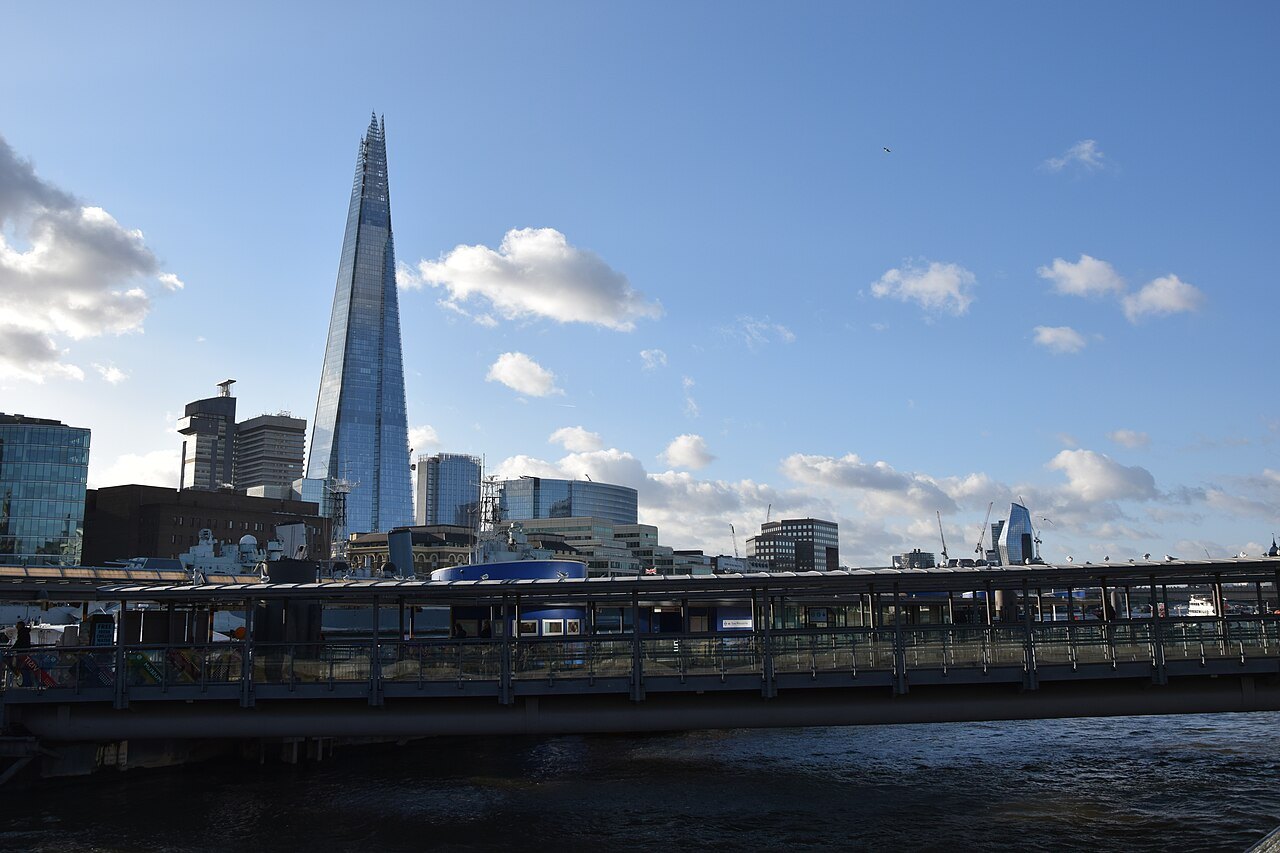
For the classic view of the whole bridge, with both towers and the suspension spans in frame, stand on the north bank near the Tower of London or cross to the south bank near the Shard, where the towers rise clear above the river rather than foreshortened from directly underneath.
A walk along the south bank or the north bank brings Tower Bridge into view from many different angles as it is approached; it also marks the end of the downstream stretch of a longer riverside walk that begins at the Palace of Westminster, while the river itself, as a whole, is covered separately on the Thames page.
Tickets for the glass floor and the engine rooms are best arranged before arriving, since both sit inside the Tower Bridge Exhibition and visiting arrangements are set by its operator rather than by the bridge itself. Checking those arrangements ahead, alongside anything else worth booking for a London visit, saves a wasted trip to the foot of the towers.
More from the journal
Read next
- Tower BridgeHow do you tell Tower Bridge from London Bridge and the Tower of London?The Tower of London is a fortress, Tower Bridge is the Victorian bridge with two towers beside it, and London Bridge is a plain bridge half a mile upstream. How to tell them apart, and the story of the American who bought the wrong bridge.Read the piece →
- The Tower of LondonWhat is Traitors' Gate, and who came through it?The water-gate that carried prisoners in by boat from the Thames, and the figures tradition says passed through it.Read the piece →
- The Palace of Westminster and Big BenHow did the fire of 1834 start?How an overheated stove and an old stockpile of tally sticks destroyed the medieval Palace of Westminster in 1834.Read the piece →